This article is informed by analysis written by Kevin Townsend, Senior Contributor at SecurityWeek, drawing on findings from Abnormal AI’s 2026 Attack Landscape Report. CSB acknowledges and credits Kevin Townsend for the original insights that underpin this discussion.
For years, cybersecurity advice around phishing emails was relatively simple: look for poor grammar, spelling mistakes, and messages that “just don’t feel right”. That advice is no longer enough.
Today’s email attacks are not clumsy or obvious. They are carefully designed to look routine, familiar, and legitimate — and that is precisely what makes them dangerous.
According to large‑scale analysis of nearly 800,000 email attacks across more than 4,600 organisations, attackers are no longer focused on breaking technical systems. Instead, they are targeting human behaviour, trusted relationships, and everyday business workflows.
Email Attacks Have Evolved — And They Blend In
Modern email attacks succeed because they don’t look like attacks at all.
Instead of random spam, attackers now study how organisations operate. They understand:
- Who exchanges documents regularly
- Which software platforms are commonly used
- How invoices, approvals, and requests normally flow
They then design emails that fit seamlessly into those patterns.
As the report explains,
“The same structures, workflows, and relationships that define how an organisation operates also define where an attack can blend in undetected.”
This is particularly relevant for professional services. Law firms, accounting practices, and real estate agencies rely heavily on email for document sharing, payments, and time‑sensitive decisions. When an email looks like “business as usual”, people are naturally inclined to act — not to question.
The Three Most Common Email Attack Types
The analysis highlights three dominant email‑based attack methods:
1. Phishing (58% of attacks)
Phishing remains the most common technique, but it has changed significantly. Messages are now tailored to specific roles and industries.
Common lures include:
- File‑sharing notifications
- Brand impersonation aligned to the tools a business already uses
- Links that appear safe but redirect through multiple steps to hide malicious destinations
Over 20% of phishing emails use redirect chains, and many rely on well‑known link shorteners such as TinyURL or t.co, which appear legitimate and are rarely blocked outright.
2. Business Email Compromise (BEC)
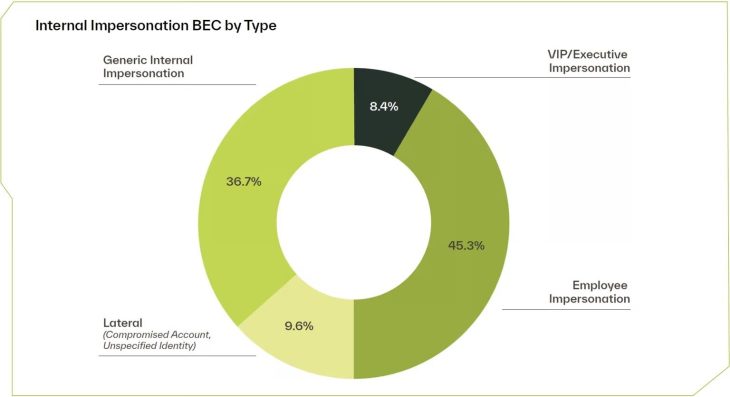
BEC attacks are less frequent but far more damaging. They involve impersonating someone inside the organisation to trigger actions such as payments, credential sharing, or urgent requests.
The tactics vary by organisation size:
- Small businesses are more often targeted through executive or VIP impersonation
- Larger organisations see more lateral attacks, where one compromised account targets others internally
Nearly 40% of BEC attacks exploit trust in colleagues, executives, or internal departments.
3. Vendor Email Compromise (VEC)
VEC is now more common than traditional BEC impersonation. It occurs when a legitimate vendor’s email account is compromised and then used to target customers.
Invoice fraud dominates these attacks, particularly where:
- Payment requests are routine
- Vendor relationships are long‑standing
- Email is the primary communication channel
As the report warns, these emails are hard to spot because billing and payment discussions happen every day.
The End of the “Obvious” Scam Email
What is very clear from this research is that the old, typo‑filled scam email belongs in the past.
Today’s attackers use:
- Carefully written language
- Familiar names and roles
- Trusted platforms and workflows
- Sophisticated evasion techniques
While the report does not quantify the role of criminal use of AI, it strongly suggests that automation and advanced tooling are now integral to these attacks.
Fighting Sophisticated Attacks with Smarter Defence
The analysis also makes an important point:
defensive use of AI can help close the gap.
Rather than relying on static rules or keyword detection, modern defence focuses on:
- Identity context
- Behavioural baselines
- Understanding what is “normal” for each employee and vendor
This allows organisations to detect when something looks like business as usual — but isn’t.
What This Means for Small and Professional Businesses
You do not need enterprise‑scale budgets to respond to modern email threats. What matters most is awareness and consistency:
- Understand how your business normally communicates
- Treat unexpected payment or access requests with healthy scepticism
- Encourage staff to pause and verify — not react under pressure
- Build simple checks into financial and document‑sharing workflows.
Final Thought
Email attacks have evolved — but so can businesses.
By recognising that today’s threats target
trust and routine
, not just technology, organisations can take practical steps to stay protected without fear or complexity.
At CSB, we believe informed people, supported by sensible security, are the strongest defence any business can have.